
Passion Project
B2C Mobile Wireframes
A Renewable Energy Application for Residential Use Cases
In this solo UX passion project, I redesigned the residential solar monitoring experience by analyzing two competing apps and identifying opportunities to make energy data more meaningful and emotionally resonant for homeowners. Through user testing and data translation research, I redesigned charts and metrics to reduce cognitive load and increase the perceived impact of solar energy production.
Stakeholders
Design
- 1 UX Designer
Users
- 2 Homeowners
Problems
Homeowners with solar panel systems want to understand if their investment is paying off, both financially and environmentally. However, usability testing with “Enlighten” and “mySolarEdge” revealed that:
- Users struggled to interpret kilowatt-hour (kWh) values for energy production or consumption.
- Participants attempted mental conversions (e.g., “Is this like a nuclear reactor?”), but still failed to make sense of the data.
- The primary motivator for opening the application—whether the homeowner would receive a credit or owe the utility company—was buried in charts that required too much cognitive effort to decode.
One moment stood out: a user became visibly delighted by the “trees planted” metric, even though they couldn’t explain what it meant. This highlighted a key opportunity: reframing raw energy data into emotionally meaningful equivalents.
Research Methods
- Competitive usability testing on “Enlighten” and “mySolarEdge”
- Think-aloud protocol with 2 users
- Solar energy equivalency research via the EPA website
Process & My role
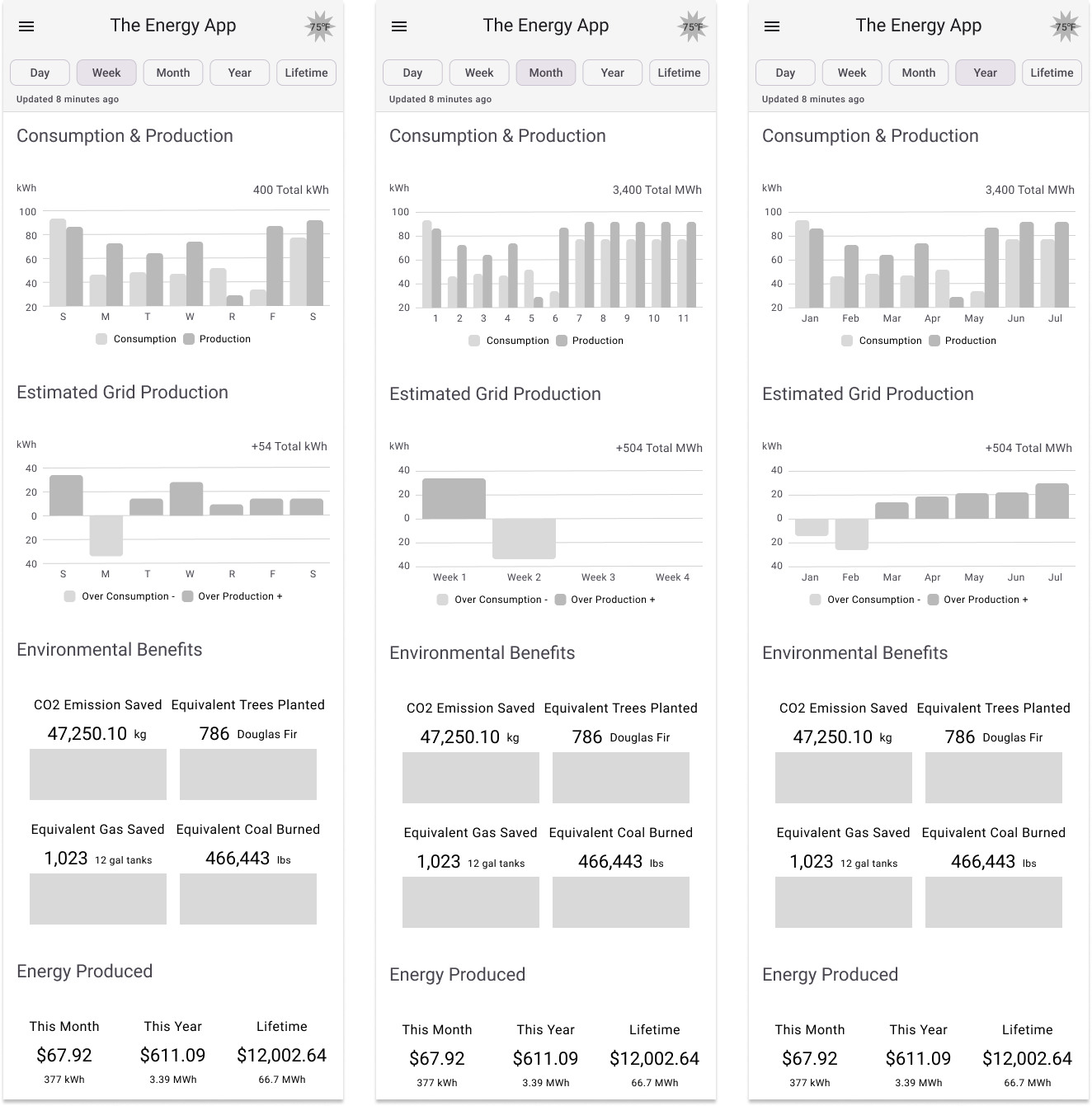
- Chart Redesign: I preserved the daily, monthly, yearly, and lifetime chart structure, but redesigned the visualizations to display the net energy balance (production vs. consumption). This removed the need for mental math, allowing users to clearly see whether they were using or exporting energy.
- Retained Familiar Elements: To reduce user friction, I retained familiar UI components, such as battery charge indicators and weather overlays, which users found helpful in their daily usage context.
- Reframing Environmental Impact:
The original “trees planted” metric was emotionally appealing but lacked clarity.- I researched the EPA’s greenhouse gas equivalencies, identifying more tangible alternatives.
- I added metrics such as pounds of coal avoided and gallons of gasoline saved, and contextualized these into the number of 12-gallon car refuels, making the energy savings feel more concrete.
- Translating kWh into Dollars:
To directly address the homeowner’s financial curiosity, I translated energy production (kWh) into estimated dollar savings based on local utility rates. This allowed users to see if their solar panels were generating a net credit or incurring a cost, providing immediate feedback on whether their system was “paying for itself.”
Solution
We delivered a redesign that provides homeowners with:
- Clearer Energy Comparison: New charts directly showed how much energy was produced versus consumed and what that difference meant in monetary terms.
- Financial Insight: Energy data now includes an estimated utility cost/savings value based on current local electricity rates.
- Environmental Equivalents: Added metrics, such as gallons of gasoline saved and pounds of coal not burned, tied to real-world imagery and context.
- Preservation of Familiar Patterns: Maintained battery levels, weather data, and time filters (daily/monthly/yearly/lifetime) to minimize learning curve.
- Increased Emotional Engagement: Environmental and financial translation of data increased motivation and pride in using clean energy.
Results
- Users could now easily understand whether they were net producers or consumers of electricity, across any time period.
- The reframed environmental metrics prompted positive emotional reactions and a stronger sense of environmental impact.
- Participants described the new interface as “easier to read”.
Reflection
This passion project deepened my appreciation for the universality of UX principles. Whether designing enterprise tools for institutional investors or consumer apps for solar homeowners, the core challenges remain the same: reducing cognitive load, creating emotional connection, and helping people make informed decisions. This project confirmed that the research and visualization strategies I’ve honed in B2B design translate beautifully to the consumer space, and I’m excited to apply them more broadly.
Let’s Chat
I’d love to learn more about your goals—reach out below, and let’s explore how we might work together.